Strength Training – Building Explosive Power
Explosive power is very key at all levels of training in order to succeed competitively and have the strength and endurance to drive the boat 2,000m faster than your competitors. Strength training is a useful tool in order to boost development and maximise performance. Rowing uses over 85% of the muscles in your body and in order to maximise their power output on and off the water, weight training can be used. Strength training, done improperly can increase the risk of injury and contribute to long term difficulties which hinder development and can even lead to an inability to row. Due to this, comprehensive stretching and muscle protection is necessary to maintain mobility and flexibility as well as maximising recovery.
Weight training for rowing has two main purposes: to increase muscle strength for key movements in the boat, and to reduce the risk of injury by improving muscular balance and the development of vulnerable areas engaged during training. This post will go into the basics of weight training and how to maximise it’s success as well as some suggested workouts/exercises which will target the key movements in rowing and the muscles which contribute to success.
The basic structure to rowing weight training through the year is key as it builds the foundations for the work you do on the water and allows you to make maximum progress. This structure consists of four blocks for training which should reflect the racing seasons and how best to prepare for them. This is an annual rotation of four blocks with a 2-4 week recovery period following summer regatta season.
Block 1: General Preparation Primary focus: Muscular balance and body composition / Secondary focus: Strength The purpose of this block is prepare your body for the more intense strength and explosive power work that comes in during winter training. It intends to build strength and endurance with little risk of injury. This is the foundation of all future weight training.
Block 2: Specific Preparation Primary focus: Strength / Secondary focus: Muscular balance and body composition The purpose of this stage is to build strength and endurance in order to progress physically for overall development on the water.
Block 3: Pre-Competitive Primary Focus: Power / Secondary Focus: Strength This block intends to develop the strength previously built and translate that into boat speed. Explosive Power is the focus of this phase and should be worked in lower reps to maximise progress.
Block 4: Competitive Primary Focus: Health and Recovery / Secondary focus: Maintain strength, muscle mass, mobility. The intention of this phase is to preserve strength and mobility while preparing your body physically for races.
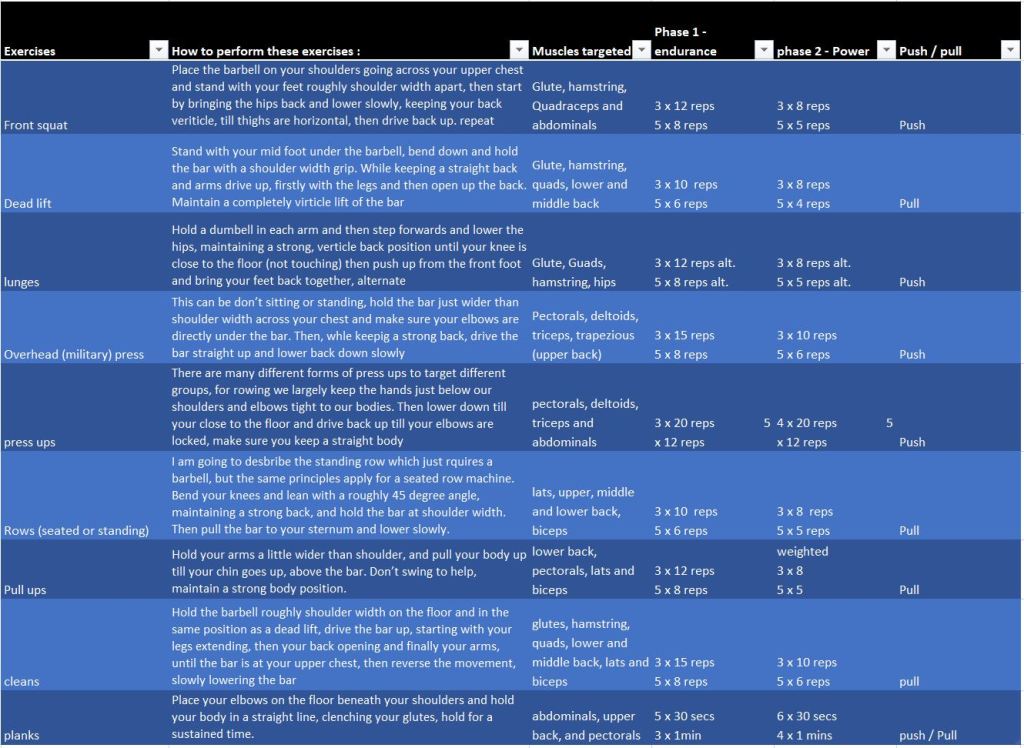
This is an explanation of some of the key weight exercises to build strength, endurance and muscle mass in order to increase power on the water. These exercises either replicate movements in the boat (clean – drive in the legs, open back, draw through the arms) or they target specific key muscles for rowing (rows – back). The most common structures to weight training include separating exercise into push/pull or by body group which are then performed in separate weight sessions. Each of these weighted exercise, performed correctly will increase strength and muscular endurance as well as reduce the risk of injury on the water. Rowing uses over 85% of the muscles in you body and this plan will target the key muscle groups which will drastically increase performance on the water.
In order to maximise the effectiveness of weight training, targeted training can be used to engage an area of development more, e.g. strength or endurance, and this can be done by varying the number or reps and subsequent weight percentages of max. The general rule is that to build explosive strength, a reduced number of reps and increased weight will target this and for muscular endurance, reducing the weight and increasing the number of reps will be more successful (examples of targeted amounts are shown in the table.)
Weight training is a key part of maximising progress and development which will hugely improve your splits on the water. It can also reduce the risk of injury through conditioning and done correctly will improve your ability as a rower to compete at a top level. This is only an overview of the key benefits of weight training and suggested plans with guidance, but please consult further guidance if you are planning on starting weight training because done incorrectly it can cause muscle imbalance and increase the risk of injury. Weight training is such a good addition to your training plan and will improve your performance on and of the water. It will develop muscular endurance and explosive power which will drastically develop you as a rower at any level.

